3 mayo 2019
The Right and Wrong Stuff by Carter Cast
The book we have read this month is The Right and Wrong Stuff. How brilliant careers are made and unmade written by Carter Cast, in which the author aims to explore the career derailment that most people suffer at some point of their professional development. “The derailment research shows that careers stall more from having […]
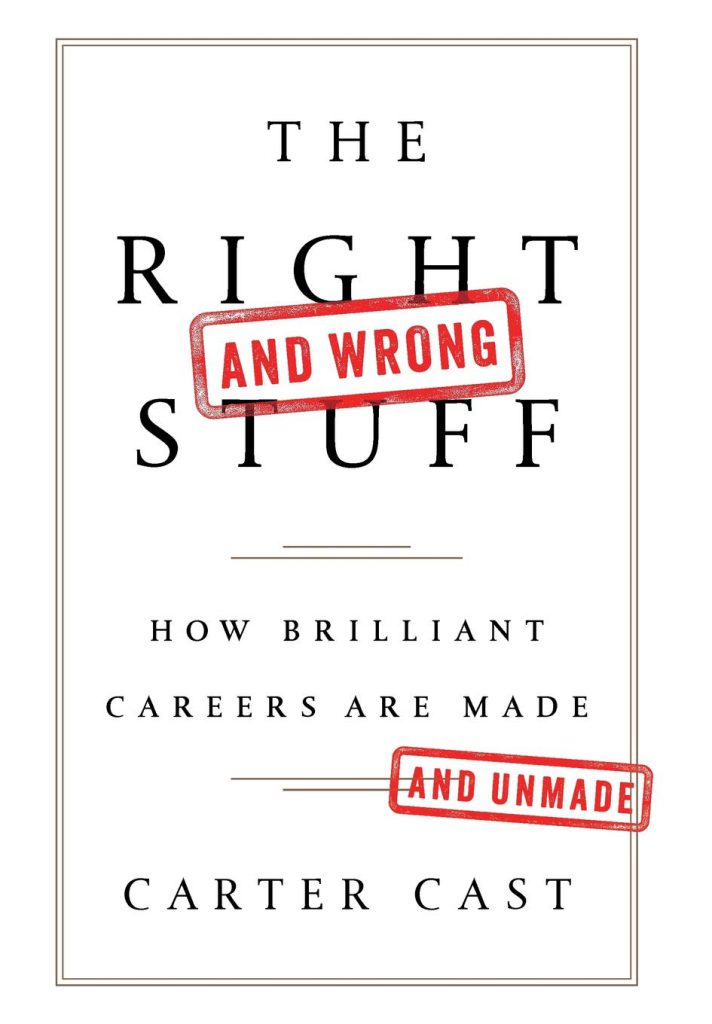
The book we have read this month is The Right and Wrong Stuff. How brilliant careers are made and unmade written by Carter Cast, in which the author aims to explore the career derailment that most people suffer at some point of their professional development.

“The derailment research shows that careers stall more from having the ‘wrong stuff’ (such as being insensitive to others) than lacking the ‘right stuff’ (for example, having strong analytical skills). The author claims that the topic ‘career derailment’ should be included as part of career development dialogues instead of focusing only on strengths, just because people need to know fully personal feedback they could use to improve their careers.
According to him, “It’s important to discover our strengths, BUT when we fail it’s because we do not understand and manage our weaknesses and vulnerabilities.” And companies have lot of work to do in this, because if they focus excessively on the positive, they do not take into consideration that “not all strengths are of equal importance. What you are good at might not be what your firm needs you to be good at”.
At the end of the book, readers can also find an interesting “derailment assessment”.[/vc_column_text]
Introduction: My blind spot and its trap door
Within the introduction ‘My blind spot and its trap door’, Cast unfolds his personal experience thathave inspired him to conduct research on the “uncomfortable” topic of career derailment.
Cast got a call from an old friend, and that call helped him to think about his professional situation. Since his twenties, Cast was part of the marketing team of the company PepsiCo that have several divisions and business around the world. Since the beginning, he received different promotions that made him feel proud enough of himself. However, due to the way he used to face his responsibilities, his boss Mike gave him negative feedback about how he was doing his job not only in terms of results, but managing people, in particular some consultants.
As usual, he felt attacked and then down. After a while analysing Mike’s words, and having a long conversation with his parents, Cast understood that his new position at the Frito-Lay business line didn’t fit him at all as he started to feel frustrated with some corporate rules and the way those regulations begins to emerge inside him: it was time to leave the company.
According to the text, Cast has an “Aha moment” as he started to understand that “success was not just about working hard and having a skill advantage […]. Even smart and talented people display behavioural problems that can stall their careers.”. It was at this point when he felt “compelled to conduct research to discover the answer of the following question:
What really impedes the career progress of talented people? Why do some careers stall while other flourish?”.
One of the main conclusionsof his investigation is that one-half to two-thirds of managers and leaders will experience career derailment, idea that drove him to the next conclusion: “there are five common reasons why it happens”. Cast expressed them through five archetypes that are the core content of the book, as we’ll see later in detail: Captain Fantastic, the One-Trick Pony, the Solo Flyer, Version 1.0, and the Whirling Dervish.
All of these five archetypesapply equally to women and men, to every age, every kind of organization (from big corporations to small ones), and regardless of their business activity. Cast shows “how these archetypes fail and succeed”, and how to recognize blind spots using ways to self-understanding.
In this introduction, readers are cautioned by Cast: the first reaction will be “none of these characters is like me”, but readers will find some aspects of this five archetypes that will help them to understand themselves better, and then improve those abilities, skills or ways of acting that may result in career derailment.
After a brief description of the five archetypes, Cast shows the second main conclusion of his investigation: there is an “overreliance on focusing on the strengths”, something that provoke may mask “a critical gal or a personal blind spot that stops talented person’s career in its tracks”. As we introduce in the beginning of this review, his derailment investigation proved that “careers stall more from having the ‘wrong stuff’ (such as being insensitive to others) than lacking the ‘right stuff’ (for example, having strong analytical skills). According to Cast, companies should work to mitigate areas of vulnerability instead of each employee, instead of focusing on strengths alone. Otherwise, that strategy will limit the career development of talented people.
While explaining his research, Cast also continued in this part of The Right and Wrong Stuff. How brilliant careers are made and unmadeto tell his personal experience. Rather than leave PepsiCo, Cast started to work for/with a senior manager from PepsiCo’s Canadian division. Within this experience, Cast recognized that the words his old boss, Mike, told him twenty years before, in that presenthad help him to improve his vulnerabilities, and thinking about what he really wanted for his professional future.
Nobody feels comfortable when your managers tell you that you are not doing well, even if you think you are… Analysing different point of view of your performance at work, people are able to develop their career better than only listening how good they are at. In his own words: “his honest assessment allowed me to better understand my own vulnerabilities and force me to face and mitigate them in order to progress in my career”.
Then, Cast explains what he understands as career derailment. For him, it extends a particular job or issue (like a skill gap), and it means “result of a lack of cultural fit between the values and motives of the individual and those of the firm itself”. At this point, he recognized that he suffered from a career derailment at Frito-Lay because his values and needs weren’t in the same direction than the corporative rules.
According to the author, “it is often hubris -not lack of talent- that causes people on the rise to fall”.
Part 1. The Five Archetypes
The author examines each of the five major reason -archetypes– for career derailment, and give advice mentioning some corrective measures.

Captain Fantastic: ‘Human Wrecking Balls who wreck themselves’
He/ She is the character who interrupt you while working with any doubt. As Cast tells us within this part, “Captain Fantastic is a human wrecking ball known for being insensitive, arrogant and emotionally volatile”.
His/her sense of humour depends on how performance works. According to the author, Captains has a poor ego that results in a “combination of arrogance and defensiveness”.
People who suffer from the syndrome of Captain Fantastic usually shows symptoms of excessive ambition, distrustful of others’ intentions, a lack of empathy for others’ feelings, and so on.
Cast mentions in the book a statement made by Marshall Goldsmith: “the single biggest career derailer I see is lack of ego management -lack of humility, of willingness to shut up, and listen and learn”.
We could conclude that Captain Fantastic is the main reason why people end up with professional problems. They have a lack of interpersonal relations when, theoretically, if you have a manager or leader position the way you relate people is more important than how much you know about a subject.
In this part, Cast uses his interviews with high performance managers of top companies such as Google while explaining his own experience. He confesses he behaved also defensive and a bit arrogant during his long-term at PepsiCo…
Another interpersonal issue he mentioned about the characteristics of C
aptain Fantastic people is that they have a lack of impulse control, being “overly dramatic”, and usually are distracted by “bright a, shiny objects”.
The Solo Flyer, ‘Step aside, I’ve got this’
The second archetype he describes in the book is The Solo Flyer. Some of the characteristics Cast defines as the Solo Flyer way of management are over-managing; hiring poorly; not communicating well to the team; not resolving conflicts; not developing subordinates, and not securing resources for their team.
On their side, Cast says this profile “is very good at executing their initiatives” and self-starting but they have difficulties in building and leading teams. Usually their teams become dissatisfied.
As well as the part of Captain Fantastic, thought the five architypes Cast weaves definitions intohis own management experience, and offers arguments and statements gathering fromthe research.
Version 1.0. ‘Inflexible and dated’
Do you feel comfortable in your routines but uncomfortable with changes? If you are not fascinated discovering new worlds, probably you feel identify with the Version 1.0. archetype.
Version 1.0. is the name Cast has chosen to define those folks who “resist learning new skills that would help them adapt to changing business environment”, who do not accept that new technologies can help them to better perform their jobs, etc., and what is more, usually become overdependent on a manager or mentor.
Cast explains in the book that these people is the kind that form part of the “resisting change team” when new management comes into their companies to “shake things up”.
The One-Trick Pony, ‘Mind the (skill) gap’
This kind of leaders are brilliant doing those tasks they are already good at. One of their main obstacles, according to the author, is their over-confidence due to their over-specialization on one thing -or skill. As result, “they become one dimensional and non-promotable”.
Another key issue on this way of management is they do not realize they need to change, becoming “pigeon-holed into doing one thing for their firm”.
What is more, their experience is based around the same “thing”, so their profile lack of a broad strategic perspective. They know what they have been doing for such a long time.
The One-Trick Pony archetype do not understand how other areas or departments of their organization work, or what kind of functions they develop, just because their motto is that “we live in an age of specialization”, what “led them to take the right approach”
How this perspective affects career derailment? Their professional development is limited “because of their narrowness”
For Cast, we could summarize their professional weakness in “getting mired in the details, then not seeing big picture”; uninterested to expand their professional horizons; “not understanding the activities that drive firm value”, or even feeling overwhelmed by complexity of the real business world.
The Whirling Dervish ‘Overcommitting and underdelivering?’
People with characteristics under the name of the whirling dervish are leaders or employees who work only on-demand, they are known to over-commit and under-deliver what in most cases means that usually colleagues and bosses try to avoid working with them.
Cast defines them as the people who are always “running around the office, constantly late for meetens and complaining about their workloads”. In terms of negative impact on their professional development, whirling dervish lack planning and organizational abilities, are bad at prioritizing tasks, and also “underestimate the time and effort needed to complete projects”.
Part 2. Accelerating your own career
Within the last pages of The Right and Wrong Stuff. How brilliant careers are made and unmade, he examines ways to improve your self-understanding, and the book could be considered as an individual coaching season to learn how to listen to negative feedback and use it in the best way possible to improve our professional path.
What can we do to hold the right stuff? By examining 360 feedback data, Cast says that there are three competences that matter: learning agility (curious, open-minded and are self-starters); relationship-oriented (listen well, ask good questions and try to understand the others’ perspective of others building strong relationships within the company), and last but not least, this people drive for results (they see what needs to be done, and they do it).
At the end of the book, readers can find an interesting “derailment assessment” that can be used to check which of these negative features they already have, in order to help them to improve their personal abilities, avoiding their career stalls.
Click here to start the assessment, which is divided into five sets of questions, each one addressing a different reason of career derailment.
A piece of advice after reading The Right and Wrong Stuff. How brilliant careers are made and unmade:
If you really are aware of your weaknesses, you can keep you on the path to success.
[/groups_member][/vc_column_text]