19 junio 2019
Professional Reading Club: The Innovator’s dilemma
“The Innovator’s Dilemma is the book no manager, leader, or entrepreneur should be without” The book we recommend you this month is a disruptive innovation classic written by Clayton M. Christensen, one of the world’s top management thinker. It is called The Innovator’s dilemma. When new technologies cause great firms to fail, and it was […]
“The Innovator’s Dilemma is the book no manager, leader, or entrepreneur should be without”
The book we recommend you this month is a disruptive innovation classic written by Clayton M. Christensen, one of the world’s top management thinker. It is called The Innovator’s dilemma. When new technologies cause great firms to fail, and it was named one of 100 Leadership & Success Books to Read in a Lifetime by Amazon Editors A Wall Street Journal and Businessweek bestseller.
It is also “one of the most influential business books of all time” that provides a set of rules for “capitalizing on the phenomenon of disruptive innovation”.
The author describes this book as the result of his research about why great companies experience loss of market shares even when they still adopting and following good practices. In Clayton’s own word, The Innovator’s dilemma “it’s not about the failure of simply any company, but of good companies—the kinds that many managers have admired and tried to emulate, the companies known for their abilities to innovate and execute […] It is about well-managed companies that have their competitive antennae up, listen astutely to their customers, invest aggressively in new technologies, and yet still lose market dominance.”
The reason why? Disruptive new technologies that mandate radical changes in production and market research but are not able to find a place in the market. This situation provokes that big companies offers a late solution to obtain benefits while small organizations lead change.[/vc_column_text]
Ya puedes leer el resumen completo
As an example, Clayton use in the introduction the company Sears Roebuck, “regarded for decades as one of the most astutely managed retailers in the world”, but that fail due to ignoring repeated predictions of a turnaround, in other words, “the rise of discount retailing and home centres” in the mid-1960s.
Something like that, explains the author, happened to the computer industry, taking as an example the case of IBM, which missed the opportunity of keeping its dominance on this market of the mainframes just because they did not detect the emergence of minicomputers. “In fact, no other major manufacturer of mainframe computers became a significant player in the minicomputer business”.
So why apparently “perfect” organizations can fail at some point? Because “what this implies at a deeper level is that many of what are now widely accepted principles of good management are, in fact, only situationally appropriate”. Managers have to know and adapt to what Clayton calls principles of disruptive innovation. And the aim of the book is basically technology, what means “the processes by which an organization transforms labour, capital, materials, and information into products and services of greater value”.
The book is divided into two parts, split up into different chapters. In part one, chapters 1 to 4, the author “builds a framework that explains why sound decisions by great managers can lead firms to failure”. In part two, chapters 5 to 10, Clayton explains why and under what circumstances new technologies have caused great firms to fail, then losing their positions of leadership. In part two, the dilemma is solved.
Part One: Why great companies can fail
Building the framework: The author starts this part making a clear distinction between two adjective that fit technology, the aim of the book: sustaining technologies and disruptive technologies.
From the writer point of view, “most technological advances in a given industry are sustaining in character”; and after the research he drove, we can affirm that rarely even the most difficult sustaining technologies make companies fail.
However, Clayton explains that the implementation of disruptive technology is one of the main reasons why companies fail, or even go to bankruptcy. When occasionally disruptive technologies emerge, that innovation could result “in worse product performance, at least in the near-term. Disruptive technologies bring to a market a very different value proposition than had been available previously. Products based on disruptive technologies are typically cheaper, simpler, smaller, and, frequently, more convenient to use”, finding multiple examples such as the ones mentions before.
The second factor that applies to this failure framework develop among the introduction by the author is the fact that “technologies can progress faster than market demand”, what means that sometimes, in order to be better than our competitors, organizations “overshoot their market”. Clayton mention here another, and more important impact of this practice: “disruptive technologies that may underperform today, relative to what users in the market demand, may be fully performance-competitive in that same market tomorrow”, as it happens to IBM with the development of personal computers.
Clayton explain that in the figure below that have been taking from the book:
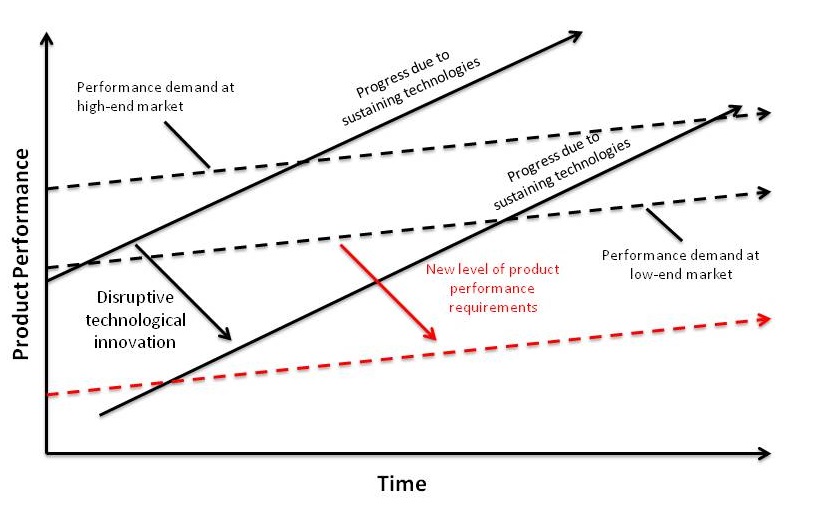
Disruptive technologies Vs- Rational investments is the third and last element Clayton points at as one of the factors that make companies fail: “investing aggressively in disruptive technologies is not a rational financial decision for them to make” due to, among other reasons, lower margins instead of greater profits.
Let’s now discover how Clayton test the failure framework…
As said before, The Innovator’s dilemma book explains “the problem of disruptive technologies and describes how they can be managed”, using real examples: among chapters 1 and 2, Clayton deeply explains the first case: why the disk drive industry failed.
1. How Can Great Firms Fail? Insights from the Hard Disk Drive Industry
Would you like to discover the history of the disk drive industry? Then, you should not miss this chapter that will help you to understand that not always is a good idea to just “keep close to our customers”, when predictions is saying you should not do it.
In this chapter 1, Clayton finds out here the two types of innovation we explain at the beginning of this text: sustained and disrupted, and how them affect to the innovation process but also to the failure of good and strong organizations, “by describing prominent examples of each and summarizing the role these played in the industry’s development”.
In this chapter, Clayton also describes different hypothesis he used trying to test how is possible that great firms fails; some of them were wrong like the one he called “technology mudslide hypothesis”.
The main conclusion is that “there are several patterns in the history of innovation in the disk drive industry”, and also that the main problem established firms “seem unable to confront successfully is that of downward vision and mobility. In other words, there were successful implementation of sustaining innovations by established firms but they fail when dealing with disruptive ones.
Why? Read chapter two…
2. Value Networks and the Impetus to Innovate
In chapter 2, the author aims to propose “a theory of why good companies can fail, based upon the concept of a value network”. For him, the value network concept seems to have greater power.

In other words, Clayton concludes that sometimes, apart from badly use or adoption of either sustained or disruptive technology, good companies fails because of its internal structure, what means that they have organizational barriers that clearly the source of the problem.
In Clayton words, “the organization’s structure and the way its groups learn to work together can then affect the way it can and cannot design new products”. In this chapter, readers will find the implications of value networks framework for innovation, taking into consideration that value networks “define and delimit what companies within them can and cannot do”.
3. Disruptive Technological Change in the Mechanical Excavator Industry
In chapter 3, readers will find that Clayton explores the external validity of the failure framework—the conditions in which we might expect the framework to yield useful insights. More in particular, Clayton analyse it in the Mechanical Excavator Industry.
The case of the mechanical Excavator Industry history shows that this industry had adopted sustaining innovations, but real problems appeared to great firms when a disruptive technology arrived: hydraulics. More in particular, the example you will find in the book is the Hydrohoe Manufactured by Bucyrus Erie.
To summarize, we can conclude in this chapter that is not bad for sustaining technologies “working hard, being smarter, investing more aggressively, and listening more astutely to customers; they are all solutions”, but, this patters do not work or are useless “-even counterproductive, in many instances—when dealing with disruptive technology”.
4. What Goes Up, Can’t Go Down
In chapter 4, Clayton deeply explains why the global “integrated steel makers floundered in the face of minimal technology”. In this chapter, we learn how the company Nucor create what is call as thin-slab casting technology, considered nowdays a disruptive technology, allowing them “captured 7 percent of the massive North American sheet market by 1996”.
Within its history, the author also conclude that, as well as in the hard disk and excavator indutries, steel companies fail to just innovate through “aggressive investments, rational decision making”, and what is more important, very close attention “to the needs of mainstream customers, and record profits. Nucor saw the corner where best develop a disrupute innovation in the steel market, and win!
Part 2: Managing disruptive technological change
To summarize part two, we would like to use this sentence form the book: “Chapters 5 to 10 suggest that although the solution to disruptive technologies cannot be found in the standard tool kit of good management, there are, in fact, sensible ways to deal effectively with this challenge”.
The aim of part two is to suggest the five principles of disruptive technology, that can be summarized with the following statements copied directly from the book:
- Principle #1: Companies Depend on Customers and Investors for Resources
- Principle #2: Small Markets Don’t Solve the Growth Needs of Large Companies
- Principle #3: Markets that Don’t Exist Can’t Be Analysed
- Principle #4: An Organization’s Capabilities Define Its Disabilities
- Principle #5: Technology Supply May Not Equal Market Demand
What readers will also what and how companies leaders and “managers can do to harness or accommodate them”.
5. Give Responsibility for Disruptive Technologies to Organizations Whose Customers Need Them
In Chapter 5, Clayton uses as an example of disruptive innovation the history of discount retailing.

The reflection here is the following: when managers face with a disruptive technology customers’ have said don’t want, then the company said also not, how should they manage that situation? According to Clyton, they’ve got two possibilites:
- One is to persuade board members to do it at any cost as, as a manager, you are firmly convinced that that disruptive innovation means a long-term strategy relevant for the company, despite importance “despite rejection by the customers who pay the bills and despite lower profitability than the upmarket alternatives”.
- The second option is to set up an independet organization and “embed it among emerging customers that do need the technology”.
In order to get an answer to which option would be better, Clayton analyse the history of Woolworth, the first five-and-dime stores in Northamerica.
They were pioneers using this model: sold discounted general merchandise at fixed prices. But it wasn’t like that since the beginning; they held two different cultures, under two different brands, one with and other without discounts. What happened? According to Clayton, “Unfortunately (but predictably), proved unable to sustain within a single organization the two different cultures, and two different models of how to make a profit, that were required to be successful in variety and discount retailing.
Readers will also find in this chapter others case of study from the retail industry hard disk (DEC) and steel industry to make us think about the importance of “harness rather than fought the forces of resource dependence”.
6. Match the Size of the Organization to the Size of the Market
In Clayton words, chapter 6 “examines the emerging personal digital assistant industry and reviews how the electric motor control industry was upended by disruptive technology”.
What would you learn from this part? There are two main findings in this study: “leadership is more crucial in coping with disruptive technologies than with sustaining ones”; the second one is that “emerging markets cannot solve the near-term growth and profit requirements of large companies”.
The company that Clayton analyse to conclude the assertions above is the history of Apple, but also, situations where large companies wait “for emerging markets to get large enough to be interesting”.
7. Discovering New and Emerging Markets
How could you analyse something you don’t know yet? The first piece of advice you will find in this chapter is that “markets that do not exist cannot be analyzed, then, suppliers and customers must discover them together”.
The second lesson here is that managers leading disruptive innovation must keep in mind that their decissions, strategy and facts, let’s say, their “plans are for learning and discovery rather than plans for execution”.
In this chapter, Clayton “recounts how entrants using disruptive technologies in motorcycles and logic circuitry dethroned industry leaders”.
8. How to Appraise Your Organization’s Capabilities and Disabilities
The premise here is based in the lesson learnt within The Innovation’s dilemma: within the history, “only companies that succeeded in addressing disruptive technology were those that created independent organizations whose size matched the size of the opportunity”, Clayton says.
In this chapter, Clayton analyses the elements of the framework that affect what an organization can or can not do it: its resources (things, or assets), processes (procedures), and values (defined by Clyton as “the criteria by which decisions about priorities are made”). He uses here what he called resources-processes-values (RPV) framework, and analyses how these factores interact to each other at the same time that explains how they impact on the way companies innovate.
Clayton focus here in the case of Digital Equipment Corporation (DEC) that had the adequate RPV framework, but was “incapable of succeeding in the personal computer world when the personal computer market began to coalesce in the early 1980s”, what cause DEC to stumble.
One of the lessons here is that companies facing with innovation, must know the importance of creating capabilities to cope with change (internally, externally, etc.).
9. Performance Provided, Market Demand, and the Product Life Cycle
Clayton set the following questions to introduce this chapter 9: “What can happen when the performance supplied exceeds the market’s demands?”
When does a product become a comodity? How does customers chose a product when everything is chaging in that industry? In this case, Clayton analyses different markets as disk drives, software development, healthcare, etc. Accordint to Clayton, “when the performance of two or more competing products has improved beyond what the market demands, customers can no longer base their choice upon which is the higher performing product. The basis of product choice often evolves from functionality to reliability, then to convenience, and, ultimately, to price”.
What about the Product Life Cycle in emerging markets and new products? Readers will also discover two important features of disruptive technologies that consistently affect product life cycles and competitive dynamics:
- The weaknesses of disruptive technologies are their strengths.
- Disruptive technologies are typically simpler, cheaper, and more reliable and convenient than established technologies.
10. Managing Disruptive Technological Change: A Case Study
In chapter 10, Clayton explains the case study of the electric vehicle, “summarizing the lessons learned from the other industry studies, showing how they can be used to assess the opportunity and threat of electric vehicles, and describing how they might be applied to make an electric vehicle commercially successful”.
How does he do it? With action! Clayton developes a case of study positioning himself as “a program manager responsible for electric vehicle development in a major automobile manufacturing company located in California”. He studied if electric vehicules are in fact a disruptive technology, and suggests a “methodology and a way of thinking about the problem of managing disruptive technological change that should prove useful in many other contexts”.
Summary
11. The Dilemmas of Innovation: a summary
Chapter 11 summarizes the Clayton book’s findings. According to the first lines the authors says, “One of the most gratifying outcomes […] is the finding that managing better, working harder, and not making so many dumb mistakes is not the answer to the innovator’s dilemma”.
Lesson #1
Do not be afraid of innovation: “products that do not appear to be useful to our customers today (that is, disruptive technologies) may squarely address their needs tomorrow”.
Lesson #2
Complexity: “One major reason for the difficulty of managing innovation is the complexity of managing the resource allocation process”.
Lesson #3
“Disruptive technology should be framed as a marketing challenge, not a technological one”.
Lesson #4
“The capabilities of most organizations are far more specialized and context-specific than most managers are inclined to believe”. New markets enable by disrutive technology requiers, in most cases, new and very different capabilites.
Lesson #5
Open mind and be ready to failure as the disruptive innovation is risky and requieres a high tolerace to unsuccess, at the same time than a new PVR framework.
Lesson #6
Companies need to take distinctly different postures depending on whether they are addressing a disruptive or a sustaining technology. Leader or follower? Depends on the matter…
Lesson #7
The role of economists: “because disruptive technologies rarely make sense during the years when investing in them is most important, conventional managerial wisdom at established firms constitutes an entry and mobility barrier that entrepreneurs and investors can bank on”.
Find out more about the author in his official webiste.
[/groups_member][/vc_column_text]