25 julio 2019
Professional Reading Club: The knowing-doing gap. How smart companies turn knowledge into action
The book we have chosen this month tries to answer questions such as why we can’t get anything done, and why organizations stuck in good intentions rather than in good actions. The authors of The knowing-doing gap. How smart companies turn knowledge into action, Jeffrey Pfeffer and Robert Sutton, both prestigious professors at different departments […]

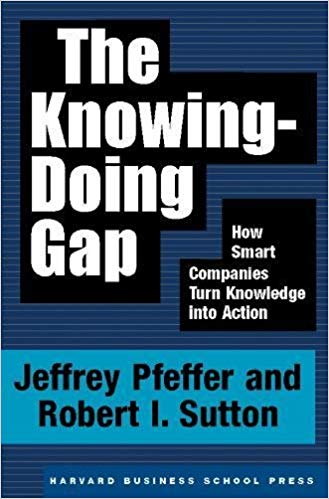
The book we have chosen this month tries to answer questions such as why we can’t get anything done, and why organizations stuck in good intentions rather than in good actions.
The authors of The knowing-doing gap. How smart companies turn knowledge into action, Jeffrey Pfeffer and Robert Sutton, both prestigious professors at different departments at Stanford University, explore “how companies can turn talk into action, and why promoting internal competition may not help”.
They emphasize the idea that “intellectual capital and knowledge work are increasingly important”. That’s right. But the problem they point out in this book is that, despite its main role, knowledge is actually not action, this idea is explained using real example companies that define “overcoming the knowing-doing gap to build a culture of implementation”.
This book is divided in different parts: Preface, eight chapters and, at the end, the reader will find what they called the The knowing-doing survey.
Pleffer and Sutton write in the preface their declaration of intent, the reason they decided to write this book published in 1999, but it still applies for a massive number of organizations worldwide.[/vc_column_text]
Preface
Pleffer and Sutton write here their declaration of intent, the reason why the decided to write the book that was published in 1999, but still applies for a massive number of organizations worldwide.
It basically tells that, after writing a couple of management books and vast amounts of articles co-written with other investigators, evidently including Sutton, Pleffer was curious to know why “people knew what to do, but didn’t do it”, also supported by the thought of why his colleagues didn’t do anything remotely related to what they taught when they found themselves in leadership roles”.
He knew that the act of doing was definitely not enough for a company, so Pleffer decided to conduct long-term research, asking his colleague Sutton at Stanford University for help to discover what factor or factors acted as a major brake on the organizational knowing but not doing practices even when they are led by smart people who know what they should do… Both Pleffer and Sutton believe that this statement was one of the most important obstacles to organizational performance, so they started to investigate the knowing-doing gap using both qualitative and quantitative field methods. It took them lots of effort and four years to finish their program that finally led to the realizarion of this book.
According to the authors, “we devoted a full year to a failed collaboration with a consulting firm […] We were inspired by the successful firms we studied, in which setbacks and mistakes were viewed as an inevitable, even desirable, part of being action oriented […]”.
They thank here a large number of colleges, editors, relatives, institutions, and more surprisingly, their students who helped them to find enlightening case studies that contributed to the conclusion that the knowing-doing gap exists.
1. Knowing what to do is not enough
Within this chapter, the reader will find out how the authors led to the of knowing-doing concept.
It starts with the following question:
Why does so many education and training, management consulting, and business research and so many books and articles produce so little change in what managers and organizations actually do?”
What happens with knowledge written in books and articles?
According to American researchers, the answer is related to the fact that most of the thousands of books published every year in United States are filled with similar content, but using different words, figures, etc. than other books published in previous years. What’s most alarming is that although “widely known and proven to be useful and valid, remain unimplemented”, the author’s aim is that managers go into action, but they just read and acquire knowledge, they don’t put their knowledge into practice.
What happens with the investment in training?
“Management education is often ineffective in changing organizational practices”, despite of the quality of the training programme, the delivery or the frequency of the lessons.
In this part, the readers will find multiple cases of study the authors explain within these pages. One of the most striking cases here is one consulting firm asked the executives they wanted to sell their services why they were willing to pay “for the same answer a fifth time”, concluding this way an agreement.
In the same way, another thought Pleffer and Sutton explains in this part is to make the reader think about why most of the main top North American companies do not recruit people at the leading business schools, saying that just a little of what these people learn in college/business schools “really prepare would-be managers for the realities of management”.
Then, why we still doing the same? Trying to figure the mystery on organizational management, when knowledge of what needs to be done fails to result in action, led to the concept knowing-doing gap problem.
Hereinafter, the book presents what the authors learned about those factors and the cause that “contribute to the knowing-doing gap and why and how some companies are more successful than others in implementing their knowledge”.
One of the main conclusions they found reading thousands of cases of study is that is cross-sectional issue. As said before, they also asked their students from their business and engineering schools, to do their own case study of knowing-doing problem including also how these issues have been, o might have been, repaired.
However, the authors highlight that “we will not present detailed descriptions of each of these practices or an extensive review of the evidence showing their positive effects on performance”, but they provide readers with insights of relevant sources of knowing-doing problems, and examples of companies that suffer from, and other that do not.
Why? Because they wanted to focus on understanding the obstacles to turning knowledge into action and how some organizations do to overcome them. The answers, obviously, were not simple… For example, just some of the few how do not have that issue “would not enjoy the substantial competitive advantages that they do”.
“One of the most important insights from our research is that knowledge that is actually implemented is much more likely to be acquired from learning by doing than from learning by reading, listening, or even thinking”.
What about the employees? What is the real reason then that some organizations succeed while other fail? Apparently, this difference comes from the management system than form the quality of the people working at. “Great companies get remarkable performance from ordinary people”.
By the end of this first chapter, the authors explain in detailed which are the evidences they identify to confirm there is a real knowing-doing gap issue, and how it has been measure that able them to create a tool compound of 26 statements managers, assistant managers and leaders had to answer using a six-point scale from strongly disagree to strongly agree.
2. When talks substitutes for action
In some many articles we have posted on our websites we explain the fact that companies and professionals need to reduce the time we spend in meetings that are not as efficient as they should be. Valuable time, resources and money are worthless if there is not a later action.
And that is the main idea the authors explain among the second chapter, When talks substitutes for action.
Contrary to what it could seem, talking about problems, processes or purposes in meetings is not an action itself. Without acting organizations cannot get any feedback to put in practice the knowledge professionals acquire, then can think they do something.
Have you ever experienced a flashback while participating in a meeting? Probably your answer is yes. But as the authors say in the book, “a decision, by itself, changes nothing.” Not even writing reports without an action could be considered as a benefit to any organization.
According to the researchers, “mission statements are among the most blatant and common means that organizations use to substitute talk for action […] There seems to be little connection between how much effort an organization devotes to planning or even how well it does planning and how well it performs.” If professionals do that, they are just doing an academic exercise, but we are no longer at college, we are working at a company which need actions to be taken to grow, to expand, to survive… Words by themselves means nothing to this scenario.
 3. When memory is a substitute for Action
What authors try to tell us in this third chapter is even if we tried something in the past, and it did not work, it does not mean that that system, process, idea, etc. would not work in the present.
They support the fact that most organizations change scenarios, activities, people, managers, products and services among the years, so why not use the memory to do an action instead of using it to stop doing what we think it could work?
As said before, it is important to keep in mind the importance of “learning by doing”, also when apply to past failed projects or initiatives. For that matter, the authors quote David Kelley: “This is the best we can think of right now. But the only thing I am sure of is that it is temporary, and it is wrong. We just have to keep experimenting, so it keeps getting better all the time.” This quote signals learning continual because the landscape keeps changing.
Another risky behaviour the authors point out in this chapter about past experience stopping the action of doing is the idea of “nothing fails like success”. It means that when an organization accumulate successes, they usually stop learning the necessary amount of knowledge they need to run better its business, and this is in most cases related to its memories from past experiences: we are satisfied with the idea of having the right answer, so we then resist to reflect and thinking about how to take knowledge into action to improve our results.
4. When fear prevents acting on knowledge
As it occurs when we think that something we do in the past can or cannot be done again (see chapter three), without taking into consideration the changes “our environment” suffers, fear is another word that is also a common status that share companies that has the knowing-doing gap problem.
Pfeffer and Sutton based this fourth chapter on the Principle number 8 of the 14 points of management effectiveness W. Edwards Deming’s, called Drive Out Fear, in which Deming claim for erase “fear acts” from all type of business management in aims of increase employees’ motivation.
They both agree that sentences such as “That is not acceptable”, «Don’t question it, do it» have no room in a company if we want to be more competitive in the market an organization operates. On the contrary, the authors ask managers and leaders to remove all kind of fear from their organizational management, creating for example places where employees feel safe to express their good or bad ideas, this is not the matter.
If we want that our company solves its knowing-doing gap issue, they need to provide employees with tools and spaces where when someone takes a risk, despite of the result, “must be honoured and sometimes rewarded”.
Otherwise, there would not be space for innovation, a must-have in the 21st Century rather than ever.
The following suggestions are quoted in the book for driving fear out of the organization:
- “Prediction: Give people as much information as possible about what will happen to them and when it will happen”.
- “Understanding: Give people detailed information about why actions, especially actions that upset and harm them, were taken”.
- “Control: Give people as much influence as possible over what happens, when things happen, and the way things happen to them; let them make as many decisions about their own fate as possible”.
- “Compassion: Convey sympathy and concern for the disruption, emotional distress, and financial burdens that people face”.
5. When measurement obstructs good judgment
Authors drive us into the fifth chapter in which they explain through some real examples those situations When measurement obstructs good judgment.
Here, and after studying and writing dozens of articles about employees’ motivation, the researches claim for the removal of ‘rank’ measure to encourage people to perform better their job.
According to the book, when measurement obstructs good judgment, the consequences for the staff and the organization will appear at short-term: “Morale governs motivation which is key to timely product development; strong culture fosters a healthy work environment” and that “employees need rewards for key contributions and successes.”
To prove that, the researchers bring as an example big companies that stop measuring their professionals with rankings such as the best employee of the year and so on. On the contrary, both Pfeffer and Sutton support the idea that “The metrics should also be aligned with the behaviour we want to see. For example: measuring sales at the expense of relationships may not be a long-term success indicators”.
What is more, they say that “real control does not come simply from having a plethora of outcome measures. Control and improvement come from measures that provide information about processes, measures that give people immediate and understandable information about how they need to act.”
6. When internal competition turns friends into enemies
The sixth chapter, When internal competition turns friends into enemies, goes further into the study of successful orientation within rankings and awards between people working at the same area, between different departments, and so on.
“Internal competition makes it even more difficult for people to put knowledge into action and to learn from each other”.
They analyse how this kind of old-fashioned motivational model instead of building and strengthen the teamwork, creates a bad environment, which could be risky for the organizations itself.
According to the authors: “The beliefs about competition are so ingrained that they serve as mindless, automatic, but powerful principles for organizing and managing individual behaviour.”
The conclusion here is that managers and executives must be careful when establishing concrete measures to run an internal competition. Otherwise “that short sighted process will ultimately defeat the system”. Also, they support in this chapter the idea that motivation is something that is difficult to generalize, as “motivation is the key factor to individual success “which will drive organizational success. Learn what others do and improve it”.
7. Firms that surmount the knowing-doing gap
How do they do it? What is their key to succeed? The right corporate culture comes to light in this seventh episode.
This chapter is about those organizations that with effort found how they could full the knowing-doing gap. As they say at the beginning of the book, they do not reveal any confidential key or factor they found out conduction this long-term research.
The cases the authors choose to deeply study these few and rare cases are British Petroleum, Barclays Global Investors, and the New Zealand Post; all of them have been successful at either avoiding the knowing-doing gap or transcending barriers to turning knowledge into action.
Thus, readers will discover in this part the following conclusions: “spaces for conversations that lead to action, collected later and used for reflection for continuous improvement. It takes leaders, leadership, and honest conversations about important issues to create a culture good for the people working in the system and ultimately the customers.”
 8. Turning knowledge into action
This chapter works as the summary of the Knowing-Doing Gap book, so we collect here some quotes to provide readers the main ideas of how companies that succeed remove the gap between knowledge and action.
- “There is no doing without mistakes. What is the company’s response?”
- “Reasonable failure should never be received with anger.”
- “Clayton Christensen: “What companies need is a forgiveness framework, and not a failure framework, to encourage risk taking and empower employees to be thinking leaders rather than passive executives.”
- Close the GAP – Release new energy for yourself and others to put great ideas into action.
Now. Are you ready to practice, or still thinking that just learning concepts is enough?
If you want to learn more about the authors, please have a look into the following websites:
[/groups_member][/vc_column_text]